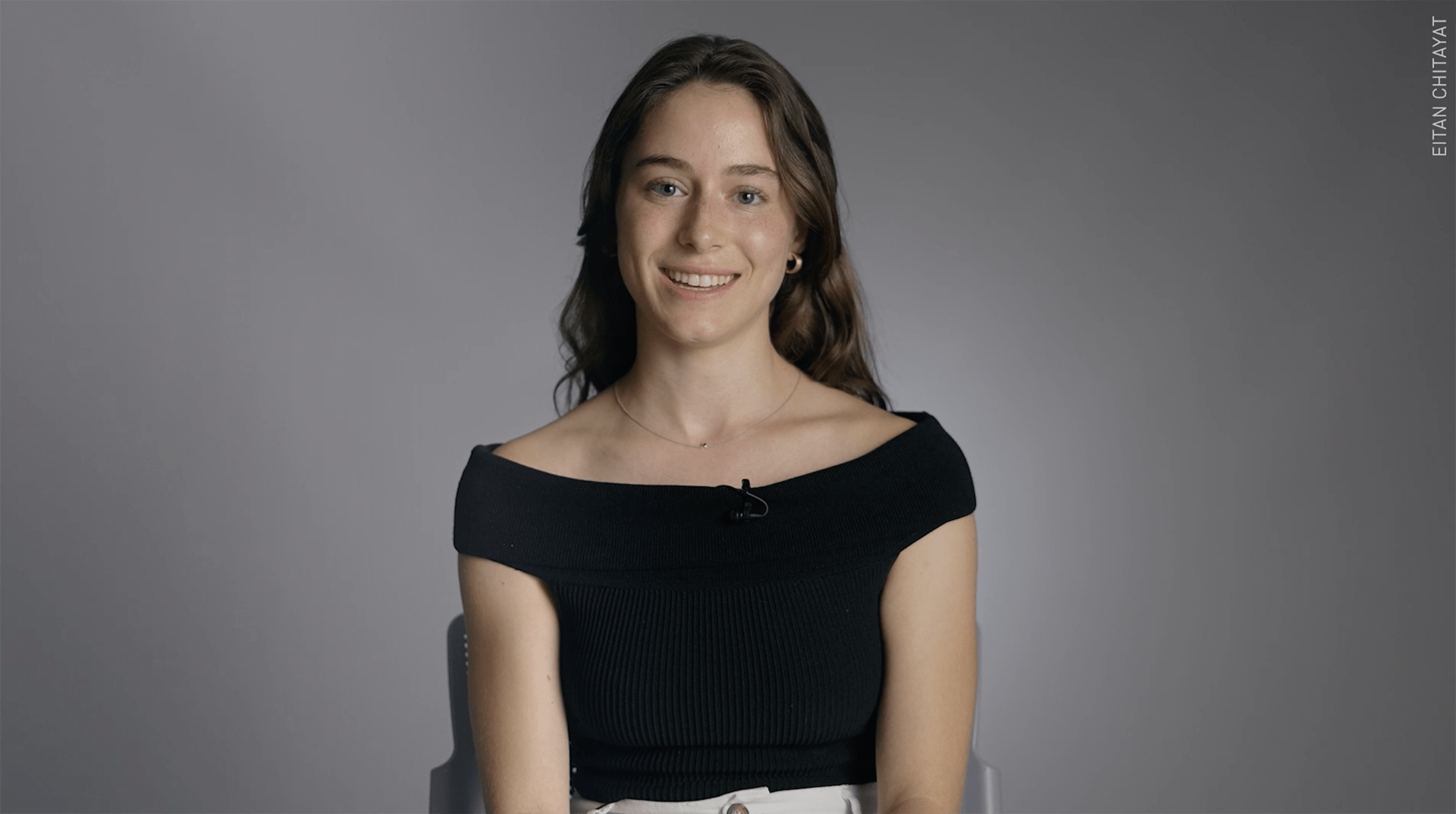
We’ll Get Through This, Together.
In We’ll Get Through This. Together., Eitan Chitayat sits down with five Jewish American college students and recent graduates to hear what it has meant to be Jewish on campus since October 7. They speak openly about antisemitism, intimidation and the silencing of Jewish voices, but also about identity, community, courage and hope. Rather than speaking for them, Eitan gives the students the space to tell their own stories. The film is ultimately about solidarity — reminding Jewish students that they are not alone, and that speaking up, standing together and staying proud of who they are can be a source of strength.
Watch the film: https://www.youtube.com/watch?v=BQxXfJ3hV-I
Key takeaways
- Jewish students faced a very different campus experience after October 7, including antisemitism, hostility and exclusion.
- The film lets students tell their own stories in their own words.
- Being openly Jewish can take courage, especially when students feel pressured or intimidated.
- Community matters — knowing you are seen and supported can make a real difference.
- These students are not just victims; they are speaking up, leading and staying connected to their Jewish identity.
- Even after a difficult year, they still have hope for a better future.
- The film asks people to listen to Jewish students and take their experiences seriously.
- The message is simple: Jewish students should not have to face this alone.
FAQs
Who appears in the film?
The film features Nathan Rosenberg, Arielle Levy, Yasmeen Ohebsion, Noah Salzman and Ava Ben-David.
Why did Eitan Chitayat make the film?
Eitan created the piece to give Jewish students a platform to describe in their own words what they had experienced after October 7 and to amplify their voices at a time when many felt ignored, dismissed or silenced.
What issues do the students discuss?
They discuss antisemitism on American college campuses, the pressure and isolation Jewish students have faced, the importance of speaking up, Jewish identity and their hope for a better future.
Is the film part of I’m That Jew?
Yes. The project is connected to Eitan Chitayat’s wider I’m That Jew advocacy work, which uses creative storytelling to strengthen Jewish identity, challenge antisemitism and amplify Jewish voices.
What is the main message of the film?
Its central message is solidarity and resilience: Jewish students should know that they are not alone, that their experiences deserve to be heard and that community, identity and courage can help people move through difficult moments together.
Film Transcript
Eitan Chitayat: On June 21st, I sat down with five bright, fierce, and incredibly inspiring Jewish American college students. We talked about October 7th and how it affected them, anti-Semitism on campus, and their thoughts and hope for a future where they can stand with pride against Jew hatred. This is what they had to say.
Nathan Rosenberg: My name is Nathan Rosenberg.
Yasmeen Ohebsion: My name is Yasmeen Ohebsion.
Ava Ben-David: My name is Ava.
Noah Salzman: My name is Noah Salzman.
Arielle Levy: My name is Arielle Levy. I attend Williams College. I’m 20 years old.
Yasmeen Ohebsion: I’m 22 years old, and I recently graduated from Tulane University.
Ava Ben-David: I am 22 years old, and I just graduated from the University of Michigan.
Noah Salzman: I am a rising junior or third year at Cornell University, and I’m 19 years old.
Yasmeen Ohebsion: I’m a first-generation American. My father immigrated to the states from Iran during the Revolution, and my mother immigrated to the states from Israel during the first Intifada.
Nathan Rosenberg: I grew up understanding my identity and culture as a Jew but really lacking a lot of the religious aspects.
Ava Ben-David: Once I got to university and I had a huge community, I did Shabbat dinner every Friday. I eventually started hosting my own dinners, baking my own challah. So it’s really an integral part of my life.
Arielle Levy: I was raised in a modern Orthodox home. We keep Shabbat at home, and then as I got older, I became less religious. But I still consider myself very traditional and a very, very proud Jew.
Noah Salzman: I think being Jewish is one of the biggest parts of my life, even though I am not at all an observant Jew.
Yasmeen Ohebsion: Before October 7, life on campus was great. I felt like I had the city of New Orleans, which is vibrant and has such a beautiful culture. I felt like I had such great friends, was involved in Greek life, really enjoyed my major.
Nathan Rosenberg: Before October 7, admittedly, it felt normal. I didn’t feel nearly the hatred that we experience now. There was no detection of this pent-up anti-Semitism, this pent-up hatred-it was all hidden.
Ava Ben-David: Honestly, before October 7, everything felt fine on campus. I never felt ashamed of my Israeli identity. I never held back sharing where I came from.
Eitan Chitayat: If you can rewind to October 7, do you remember where you were, how you felt?
Arielle Levy: I think I’ll definitely remember October the seventh forever.
Ava Ben-David: I woke up and, like most people, I checked my phone, and I immediately was completely shocked.
Yasmeen Ohebsion: And I think at the beginning I didn’t fully process what had happened.
Noah Salzman: It was heartbreaking. I didn’t understand the magnitude of the situation. I don’t think most people did.
Arielle Levy: I was at my sister’s apartment, home for the weekend, visiting her in New York City, and we picked up everything in her apartment, all of our things, and we immediately went home to New Jersey to be with family because obviously we had realized by then that this was unprecedented.
Ava Ben-David: And I walked out of my bedroom into my kitchen, and all of my roommates were kind of just looking at me, not sure what to say. Most of them just didn’t say anything.
Yasmeen Ohebsion: It felt like the people that I was surrounded by didn’t understand how I felt, and I felt helpless. I wanted to go home. I called my mom and was in tears, and she was in tears.
Noah Salzman: I remember speaking to my older sister that day about the Nova Festival, and she told me, you know, that could have been us. We could have been in Israel. We could have gone to a music festival. That could have been us.
Nathan Rosenberg: I started to see students saying this was justified. The rapes, the beheadings, all of the pain felt on October 7 was justified, and I couldn’t believe it. And it felt like I was down and just being kicked.
Yasmeen Ohebsion: And it felt like my entire world had been turned upside down. It felt like I didn’t matter.
Arielle Levy: I think that people could tell that I was really, really upset during this entire period, my grades went down. I felt very alone. I felt like no one wanted to talk to me about it because they didn’t know what to say.
Nathan Rosenberg: I remember relatively early on at the business school at Michigan, there was a very large protest that interrupted classes, and my professor notably said, “Students, go out and witness it. Go out and watch it. This is history.” I remember that was a very hard moment for me. And then later, as the encampment came up, it got so much worse.
Yasmeen Ohebsion: So the protests and the encampments at Tulane were suffocating. And my life became suffocating. The environment on campus became suffocated. People say “Fuck you.” They’ve told me to kill myself. They’ve called me a Zionist pig. People have called me a Nazi, a murderer. And then when I get home, I go on my phone, and people are telling me to go back to the gas chambers, which is so ironic because I’m Iranian.
Arielle Levy: I am a firm believer in freedom of speech, and everyone has a right to state their opinion as long as it’s respectful and nonviolent. But it did feel, oftentimes, very charged with emotion from individuals that I know have absolutely no connection to this land from either side, and that was tough.
Yasmeen Ohebsion: I don’t think people realize how deeply these comments affect us. When you intimidate us and threaten us and tokenize us, it hurts.
Noah Salzman: I think everyone can agree that the tension on campus in the past year has taken away from our ability to invest ourselves in the material that we’re learning, invest ourselves in the opportunities on campus. I’ve spent countless time in the past year, advocating for Israel, which is an amazing thing to do, but it shouldn’t be necessary. I wish that I could have spent that time in clubs, getting a job, or hanging out with friends.
Nathan Rosenberg: Going to school has been a lot different. My life has been flipped upside down. It’s taken up a lot of my identity on campus, being Jewish. It’s taken up a lot of my headspace. Every day, every second, I’m thinking about where’s the hate going to come from next. My teacher, my friend, university leadership.
Ava Ben-David: I’ve definitely lost friends O 7, and I think the most frustrating part is that a lot of them were lost without a proper conversation. Just people just don’t want to interact with me.
Arielle Levy: And you know, I would call my father. I would tell him this is happening to me. It’s horrible. I would cry on the phone. I have no community here, and he would tell me, “This is no surprise, Arielle. This has been going on for centuries to our people. Wake up. Do something. Make meaning out of all of this.” And I think that that is really what I did.
Eitan Chitayat: If you could say something to other Jewish students who might be facing similar challenges, what would you say to them?
Nathan Rosenberg: Right now is a time to become empowered. It’s a time to become a leader. It’s a time to stand up and advocate for yourselves and for the Jewish people, because people around the world are facing so much hate, and your leadership will really make an impact.
Ava Ben-David: If I could give a message, remember that you’re not alone, and there’s plenty of non-Jewish people who also want to stand up for what’s right.
Yasmeen Ohebsion: I have one message, and that is that we have never been more united. We have never been stronger. Every blow to our identities, every blow to our people, is only something that should lift us up.
Arielle Levy: Don’t sit on the sidelines like we’ve done as Jews for centuries. Join us.
Yasmeen Ohebsion: You are not alone.
Arielle Levy: We’re not weak anymore. We have a state. We’re strong. We’re driven,
Yasmeen Ohebsion: And should give us more of a reason to stand up and speak up.
Ava Ben-David: I’m that Shabbat dinner hosting University of Michigan Jew.
Yasmeen Ohebsion: I’m that don’t fall with me, Tulane University Jew.
Nathan Rosenberg: I’m that University of Michigan stand up for all students Jew.
Arielle Levy: I’m that Williams College business babe Jew.
Noah Salzman: I’m that everything is gonna be okay Cornell Jew.
- Instagram: Meet Nathan Rosenberg – Individual profile from the project; Nathan is identified as a recent University of Michigan graduate. View source
- Instagram: Meet Arielle Levy – Individual profile from the project; Arielle is identified as a Williams College student. View source
- Instagram: Meet Yasmeen Ohebsion – Individual profile from the project; Yasmeen is identified as a recent Tulane University graduate. View source
- Instagram: Meet Noah Salzman – Individual profile from the project; Noah is identified as a Cornell University student. View source